


AI in Commercial Real Estate: The Revolutionary Moment We’re In
AI in commercial real estate is no longer a distant future concept, it’s reshaping how CRE professionals work today. Commercial real estate doesn’t often move fast. Deals stretch across months, processes run on decades-old playbooks, and “digital” sometimes means scanning a PDF.
But the pace is shifting.
In 2025, Morgan Stanley estimated 37% of all CRE tasks could be automated by AI, worth $34 billion in operational gains by 2030. That’s not theory, it’s an entire extra property portfolio unlocked without adding a single square metre.
This isn’t about replacing people with machines. It’s about removing the grit in the gears so your teams spend less time pushing paper and more time moving deals forward.
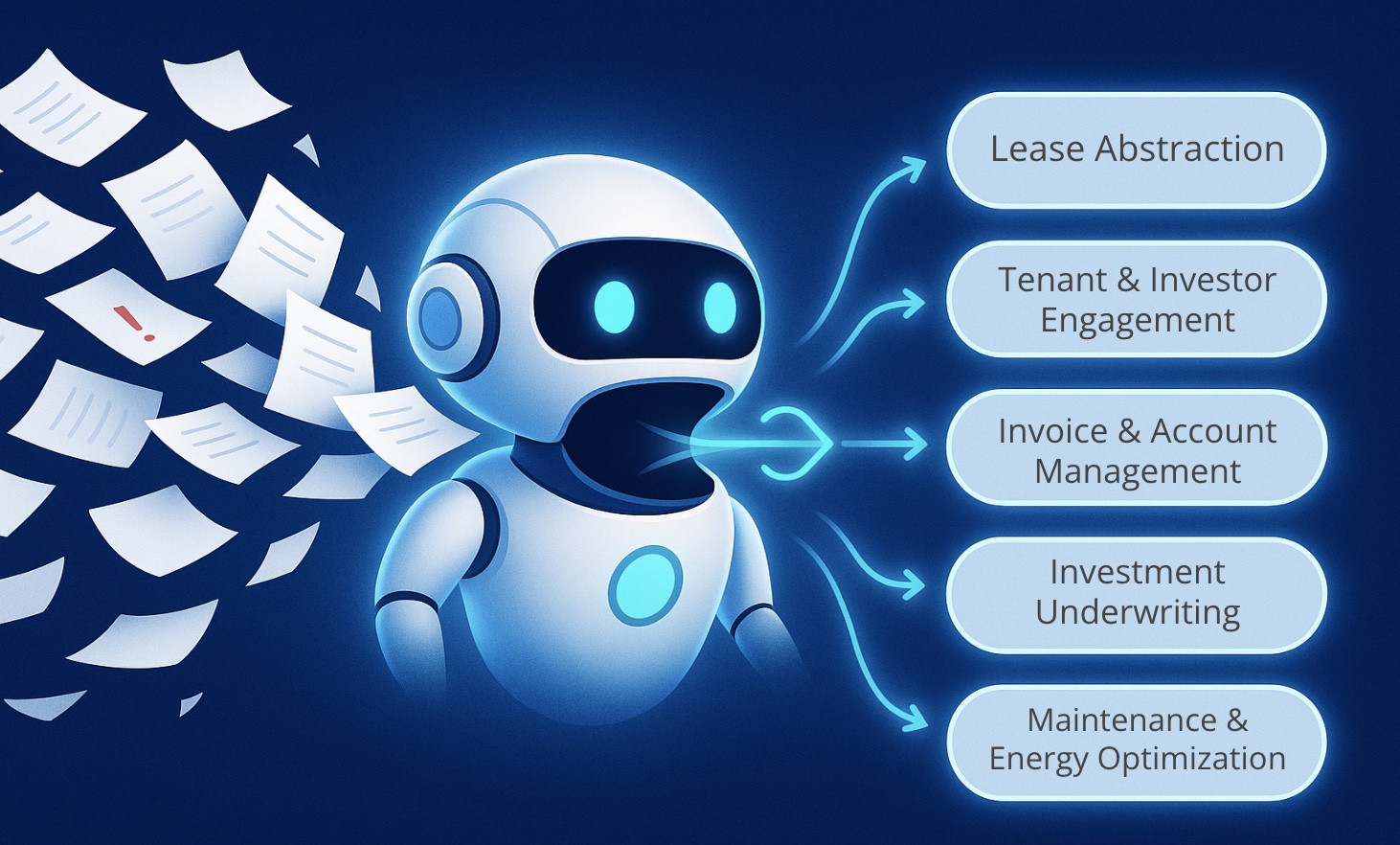
Where AI in Commercial Real Estate Agents Show Up First
If you’ve ever tried to abstract a commercial lease, you know the drill: 100+ pages of dense legal language, hours of combing through clauses, red flags, renewal dates. Traditionally, that’s three to five hours gone, sometimes an entire day.
AI in commercial real estate lease processing now completes this in minutes. AI agents don’t just find the renewal date, they cross-check it against other contracts, flag inconsistencies, and drop it into your portfolio system. Kolena’s recent study calls it “compression of weeks into hours.”
At JLL, an in-house model called JLL GPT turned a legal memorandum that used to take six weeks into a task completed in under five hours. Marketing leaders there didn’t just shave time, they started delivering client-ready materials before the next meeting rolled around.
AI in Commercial Real Estate: Inside the Toolkit
Let’s demystify what’s actually happening under the hood with AI in commercial real estate applications.
McKinsey breaks it down into four capabilities:
- Concision: Summarising lease terms or a 50-page building inspection into something a board can read over coffee.
- Creation: Drafting investor reports, market briefs, or tenant newsletters.
- Customer Engagement: AI chatbots that handle 80% of tenant questions without waiting for “office hours.”
- Coding: Stitching together data flows from your property management system, CRM, and finance tools.
These aren’t abstract ideas, they’re already reshaping portfolio management, valuation, and even sustainability efforts. AI in commercial real estate systems can now predict maintenance needs, adjust HVAC usage in real time, and recommend upgrades that cut energy costs and carbon footprint.
Commercial Real Estate AI Case Studies That Tell the Story
JLL’s 24-Hour Service Window
By pairing JLL GPT with a client-facing chat interface, JLL expanded its operational window from 9-to-5 to 24/7. This isn’t about gimmicks, it’s about meeting international investors in their time zone, not yours.
Bob Knakal’s Boutique Edge
When veteran broker Bob Knakal launched BKREA, he wasn’t competing on headcount. With a team of just 15, he fed decades of proprietary market data into AI models to streamline market research, investor targeting, and marketing content. Result? A $2 billion pipeline, proof that AI in commercial real estate isn’t just for the big players.
PredictAP’s Invoicing Revolution
In CRE accounting, processing an invoice used to mean 5–10 minutes of manual keying. PredictAP’s AI reduces that to 30–40 seconds, freeing finance teams to focus on negotiation and vendor management rather than data entry.
The AI in Commercial Real Estate Market Is Moving
The broader proptech sector is riding a steep curve, $34 billion in 2023, forecast to hit $90 billion by 2032. Within that, AI in commercial real estate adoption is accelerating:
- 89% of CRE executives believe AI can solve major operational challenges.
- More than 700 AI-powered proptech firms existed by late 2024.
- AI companies themselves now occupy 2.04 million sqm of US office space.
But adoption isn’t even. Analysts split AI in commercial real estate impact into two verticals:
- In-Asset: Optimising operations, energy, and maintenance.
- Out-of-Asset: Streamlining transactions, underwriting, and client engagement.
Why the First Steps in Commercial Real Estate AI Matter
In conversations with CRE leaders, the pattern is clear: the firms seeing the most benefit from AI in commercial real estate didn’t start with moonshots. They started with one, high-friction workflow.
- Pick a pilot. Lease abstraction, memo drafting, or tenant inquiry handling are common entry points because they’re measurable and low-risk.
- Measure the impact. Quantify hours saved, errors reduced, or deals accelerated.
- Scale deliberately. Move into connected workflows, like linking AI lease abstraction with your CRM to trigger investor updates.
This “pilot, prove, scale” rhythm keeps momentum high and scepticism low when implementing AI in commercial real estate.
The Human Side of AI in Commercial Real Estate
The fear that AI in commercial real estate will make people redundant often misses the point. The reality in most CRE firms is the opposite: teams are over-capacity, juggling more deals, tenants, and assets than they can comfortably handle.
JLL’s decision to train 400+ “AI innovators” internally wasn’t just a tech move, it was change management. People who know the business best were empowered to adapt AI in commercial real estate to their workflows. That’s where adoption sticks.
What’s Next for AI in Commercial Real Estate
In the near term, expect to see these AI in commercial real estate developments:
- Predictive Underwriting: Faster “go/no-go” on acquisitions.
- Sustainability Agents: Automated ESG compliance reporting.
- Portfolio Digital Twins: AI models that simulate financial and operational outcomes before you commit capital.
Longer term? CRE firms will see AI in commercial real estate agents embedded across the value chain, negotiating supplier contracts, optimising tenant mix, even advising on capital allocation.
Closing the Loop on AI in Commercial Real Estate
The takeaway for CRE leaders is simple: AI in commercial real estate isn’t a side project, it’s a competitive necessity. But the real gains come when it’s tailored to your data, your deals, your decision-making rhythms.
That’s where Safqore comes in.
We build AI in commercial real estate agents that don’t just “bolt on” to your existing tools, they integrate with the way you actually work. From portfolio analysis to tenant engagement, our agents are designed to save you hours, reduce risk, and surface opportunities you didn’t know were there. If you are ready to explore what AI could unlock for your CRE portfolio, contact us.
Because in a market moving this fast, the choice isn’t between AI and no AI, it’s between leading the change and playing catch-up.